Deep sleep gets shorter
The slow-wave stage — the part of the night researchers link to filing away the day’s information — naturally shrinks with age. Same eight hours in bed, less of the stage that does the filing.
Mediterranean kitchen habits · Written for readers 50+
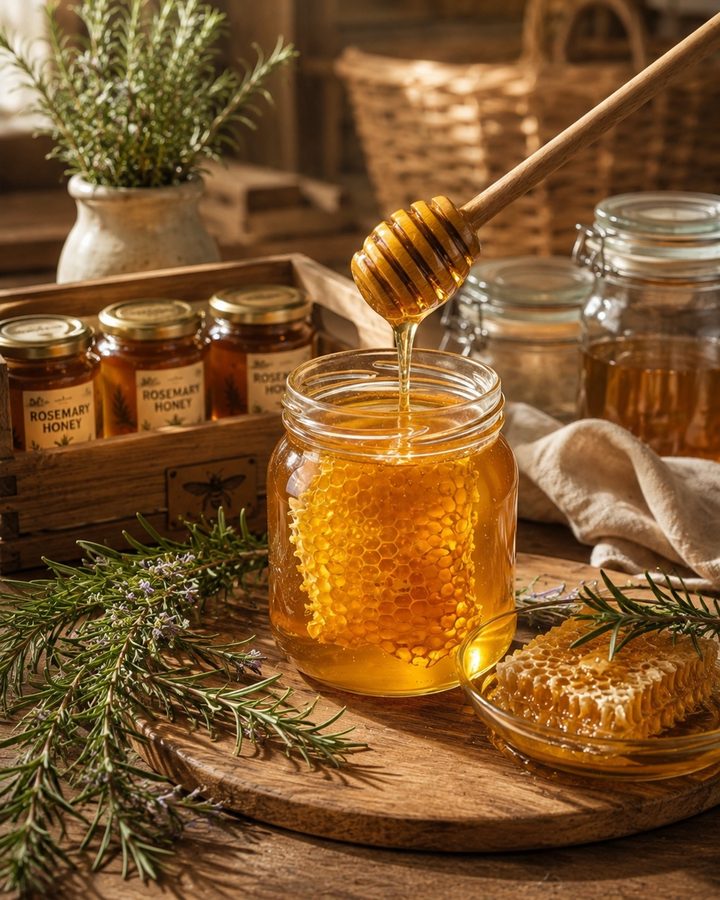
A spoonful of raw honey, a sprig of rosemary, and a routine that outlived four generations without a single instruction manual. Here is why people over 50 keep asking about it — and what it actually involves.
 Free video
Short presentation · Plays with sound · Best watched before you make the coffee
No signup. No email required. You can close the page at any time.
First, the honest part
Nothing here is a diagnosis. These are the ordinary, well-documented reasons a name takes three seconds longer to arrive at 58 than it did at 35.
The slow-wave stage — the part of the night researchers link to filing away the day’s information — naturally shrinks with age. Same eight hours in bed, less of the stage that does the filing.
The brain is roughly 2% of body weight and takes about 20% of the blood supply. As vessels stiffen with the decades, delivery gets less generous — and the brain notices before the rest of you does.
Short bursts of stress are useful. The kind that runs quietly in the background for years is a different animal, and the memory-forming region is one of the areas most sensitive to it.
By 50, most routines run on autopilot. Autopilot is efficient and comfortable — and it is also the opposite of what asks the brain to build new connections.
Clearing the table
Repeated often enough, a rumour starts to sound like advice.
Forgetting a name means something serious is starting.
Blanking on a familiar name and finding it minutes later is common at every age. What deserves attention is a pattern that changes — and that is a conversation for your doctor, not for a website.
Brain games are the answer. Do enough puzzles and you are covered.
Practising a puzzle mostly makes you better at that puzzle. The habits researchers keep studying together are duller and broader: sleep, movement, what is on the plate, and real conversation.
After a certain age the brain is finished changing. You get what you get.
The adult brain keeps reorganising and forming connections throughout life. It is slower to be impressed than a teenager’s — it is not closed for renovations.
The ritual, step by step
The order matters more than the ingredients. Each step exists because it makes the next one easier to keep.
Not “sometime in the morning”. The same window, every day, before the phone and before the coffee: daylight on your face, a full glass of water, and a spoonful of raw honey taken slowly.
The anchor is the whole trick. A habit tied to a fixed moment survives; a habit tied to good intentions does not last three weeks.
A sprig crushed between the fingers, held under the nose for a few breaths, then left on the counter or dropped into hot water. In Mediterranean households the plant lived by the door for exactly this reason.
Scent is the one sense wired almost directly into the brain’s memory circuitry, which is why a smell can drag a whole decade back without warning. The rosemary is doing double duty here: it makes the ritual pleasant, and pleasant is what makes it repeatable.
The morning half is worthless if the night half is a mess. Fixed bedtime, dim the house an hour before, keep the last meal well clear of it, and treat the first stretch of the night as the appointment it is.
Morning and night are one loop, not two habits. Most people who abandon this stop because they only ever did half of it.
It takes a few minutes and explains the part that does not fit on this page.
Where it comes from
Rosemary and remembrance have been tied together for as long as anyone has been writing things down. Greek students are said to have worn sprigs of it while studying. Mourners carried it to funerals so the dead would not be forgotten. Shakespeare put the association into Ophelia’s hands: rosemary, that’s for remembrance. That is folklore, not evidence — but folklore that stubborn usually started somewhere.
Honey has an equally long and much more practical history. Before refrigeration it was one of the few foods that simply did not spoil; jars recovered from ancient tombs were still edible. Every Mediterranean pantry kept it, and the spoonful in the morning was less a remedy than the ordinary way a day started.
The households that kept this going for four generations were not following a protocol. They were following a habit that happened to be pleasant enough to repeat ten thousand times.
Modern researchers have taken an interest in both plants — the aromatic compounds in rosemary, the natural sugars and plant compounds in raw honey. That research is ongoing, and it is worth being honest about what it is: early, mixed, and nowhere near a promise. Nobody has proven that a spoonful of anything protects a memory.
The part that gets missed
Pull the pieces apart and each one looks unremarkable. Together, at the same hour, every morning, they do something no single ingredient can: they hold a routine in place. Consistency is the least exciting word in this entire subject and the only one that reliably matters.
Everyday observations
These are common, ordinary experiences — not symptoms, and not a checklist for diagnosing anything.
You walk into the kitchen with complete purpose and arrive with none. The reason comes back the moment you sit down again.
You know their dog, their job and where they went on holiday. The name arrives twenty minutes after they have gone.
Your eyes finish the page and nothing stayed. You go back to the top and start again.
You are halfway through a point and the end of it evaporates. Someone finishes it for you, which is worse.
Not lost, exactly. Just never where the previous version of you swore they were left.
One broken night and the whole day runs a half-step behind. It clears — but you can feel exactly what it cost.
Important: recognising yourself here means very little on its own. If something has changed noticeably, if it is getting worse, or if the people around you have started mentioning it, speak to a qualified healthcare professional. A web page cannot evaluate anyone, and this one is not trying to.
In their words
Individual experiences. They describe a routine, not an outcome you should expect.
I had tried the apps, the crosswords, all of it. This is the first thing I have kept up past a month, mostly because it takes five minutes and I actually look forward to the smell of the rosemary.
My mother did something close to this every morning and I never once asked her why. Now it is the quietest part of my day and my wife has started doing it with me.
What made the difference for me was the third step. I was doing the mornings and wondering why nothing felt different, and I was going to bed at one in the morning.
Individual experiences shared voluntarily. They are not typical, not guaranteed, and not evidence of any outcome. Results vary from person to person, and nothing described here is intended to diagnose, treat, cure or prevent any condition.
Before you ask
About five minutes in the morning. The evening half is not extra time — it is a change to when you already go to bed, not an addition to your day.
Raw and unfiltered is what the tradition used, simply because that is the only kind that existed. Heavily processed honey has been heated and strained, which changes it. Beyond that, use what you can actually get and afford — a jar you keep buying beats a perfect jar you buy once.
Warm water and a squeeze of lemon changes it completely, and it keeps the same five-minute anchor. The anchor is the part that matters most.
Ask your doctor or pharmacist first, without exception. That applies to honey, to rosemary and to anything else you might add to a daily routine. This page is not a substitute for that conversation and cannot account for your situation.
Nobody can honestly answer that, and be careful with anyone who does. What people tend to report first is the routine itself feeling settled rather than effortful, usually somewhere in the first few weeks. Anything beyond that varies from person to person.
The habits discussed here are the ordinary ones — sleep, daylight, movement, what you eat, staying in real conversation with people. There is no age at which those stop being worth doing.
No. It is a daily routine drawn from traditional practice, presented for general information. It is not a treatment, not a therapy and not a replacement for medical care. If you are worried about your memory or someone else’s, see a qualified healthcare professional.
One last thing
This page covers the shape of the ritual. The presentation covers the part that does not fit here.
No signup and no email required. Close it whenever you like.
This policy explains what information is collected when you visit this website, how it is used, and the choices available to you. By using the site you agree to the practices described below.
This site uses cookies, pixels, tags and similar technologies. Some are strictly necessary for the site to function; others support analytics and advertising measurement. Most browsers let you refuse or delete cookies through their settings. Disabling cookies may affect how parts of this site work.
Analytics providers, advertising networks and hosting services may process data on our behalf or collect data through their own technologies placed on this site. Their handling of that data is governed by their own privacy policies. Personal information is not sold.
Information is retained only for as long as needed for the purposes described above, or for as long as required by applicable law, after which it is deleted or anonymised.
Depending on where you live, you may have the right to request access to the personal information held about you, request its correction or deletion, object to or restrict certain processing, request a copy in a portable format, opt out of the sale or sharing of personal information, and withdraw consent previously given. Requests can be submitted through the contact page and will be handled within the timeframes required by applicable law. You will not be discriminated against for exercising these rights.
This site is intended for adults and is not directed at children under 16. Personal information is not knowingly collected from children. If you believe a child has provided information, contact us and it will be deleted.
Reasonable technical and organisational measures are used to protect information. No method of transmission or storage over the internet is completely secure, and absolute security cannot be guaranteed.
Information may be processed and stored in countries other than your own, where data protection laws may differ. Where required, appropriate safeguards are used for such transfers.
This policy may be updated from time to time. The revised version takes effect when posted on this page, and continued use of the site after that point constitutes acceptance of the changes.
Questions about this policy can be sent through the contact page of this website.
By accessing or using this website you agree to these terms. If you do not agree with them, please stop using the site.
You may view and use this site for lawful personal purposes only. You agree not to interfere with its operation or security, attempt unauthorised access, use automated systems to scrape or copy content, or use the site in any way that violates applicable law or the rights of others.
All content is provided for general information and education. It does not constitute medical, health, legal, financial or professional advice of any kind, and it is not a substitute for consultation with a qualified professional. Statements on this site have not been evaluated by the Food and Drug Administration, and nothing here is intended to diagnose, treat, cure or prevent any disease. Always consult a qualified healthcare professional before making decisions about your health, and never disregard or delay professional advice because of something you read here.
All text, graphics, layout, design and other material on this site are protected by copyright and other intellectual property laws and remain the property of their respective owners. You may not reproduce, distribute, modify or create derivative works from this material without prior written permission. Third-party names, logos and trademarks are the property of their respective owners and their use does not imply any endorsement, affiliation or partnership.
This site is an advertisement and publishes sponsored content. It contains affiliate links, and the publisher may receive compensation for clicks or resulting purchases at no additional cost to you. The publisher is an independent third party and is not the manufacturer, seller or distributor of any product referenced. All orders, payments, delivery, returns, refunds and customer service are handled exclusively by the respective seller under its own terms and policies, which you should read before purchasing.
Links to external websites are provided for convenience. We do not control and are not responsible for the content, products, policies or practices of any third-party site, and their inclusion does not imply endorsement.
This site and its content are provided on an "as is" and "as available" basis, without warranties of any kind, whether express or implied, including any warranty of accuracy, completeness, merchantability, fitness for a particular purpose or non-infringement. No guarantee is made that the site will be uninterrupted, error-free or free of harmful components.
To the fullest extent permitted by law, the publisher and its contributors shall not be liable for any direct, indirect, incidental, consequential, special or punitive damages arising out of or relating to your access to or use of this site, its content, or any product or service referenced on it, including any decision made or action taken in reliance on the information provided.
You agree to indemnify and hold harmless the publisher and its contributors from any claim, loss, liability or expense arising out of your use of this site or your violation of these terms.
These terms may be updated at any time. The current version takes effect when posted on this page, and continued use of the site constitutes acceptance of the revised terms.
If any provision of these terms is found to be unenforceable, the remaining provisions remain in full force and effect.
This website is an independent publisher of informational and sponsored content. It does not sell, ship or fulfil any product and does not process payments of any kind.
Any purchase made after leaving this site is a transaction between you and the respective seller. Refunds, returns, exchanges, cancellations and billing questions are governed entirely by that seller's own refund policy and are handled by its customer service team.
Contact the seller directly through the customer service channel shown on your order confirmation, quoting your order number. Refund windows, restocking terms and return shipping conditions vary by seller and by product, and are set out in the seller's own policy.
If you need to reach the publisher of this page about the content itself, use the contact page. Please note that the publisher cannot access order records, process refunds or intervene in a transaction with a seller.
This website does not stock, sell or ship any product. It publishes informational and sponsored content only.
If you complete a purchase after leaving this page, the order is placed with and fulfilled by the respective seller. That seller is solely responsible for order processing, packaging, dispatch, carrier selection, tracking, delivery times and any shipping costs, duties or taxes.
Processing and delivery estimates, available shipping methods and any associated fees are displayed by the seller at checkout, before payment is taken. Delivery estimates are not guarantees and may be affected by carrier delays, weather, customs clearance, holidays and the accuracy of the address provided.
Availability outside the seller's home country varies. Where international delivery is offered, the recipient is normally responsible for any import duties, taxes or customs fees, which are not included in the purchase price.
Tracking information is issued by the seller once the order is dispatched. Missing, delayed, damaged or incorrect shipments must be reported to the seller's customer service team using the order number from your confirmation. The publisher of this website has no access to order or shipment records and cannot assist with delivery issues.
This page is an advertisement and contains sponsored content and affiliate links. The publisher may receive compensation when a reader clicks a link on this page or makes a purchase from the advertiser, at no additional cost to the reader. This compensation may influence which products are featured, how they are presented and where they appear.
All content is provided for general educational and informational purposes only and does not constitute medical or health advice. Statements on this page have not been evaluated by the Food and Drug Administration. Nothing described here is intended to diagnose, treat, cure or prevent any disease or health condition.
Always speak with a qualified healthcare professional before starting any new dietary routine, supplement or lifestyle change, particularly if you are pregnant or nursing, have a diagnosed condition, or take prescription medication. Never disregard or delay professional medical advice because of something you have read on this website. If you are concerned about your memory or your health, seek medical care.
Individual results vary and depend on many factors, including age, overall health, diet, sleep, activity level and consistency. Any testimonials or experiences shown are individual accounts, are not typical, and are not a promise or guarantee of any particular outcome.
Content is believed to be accurate at the time of publication, but no representation or warranty is made as to its completeness, accuracy, reliability or currency. Information may change without notice, and any reliance placed on it is strictly at your own risk.
The publisher is not the manufacturer, seller or distributor of any product referenced and does not endorse, guarantee or assume responsibility for any product, claim, statement or offer made by a third party. Any transaction is solely between you and that third party.